EXPLAINERWater & Food
Water, Food, Climate, and Nature: What’s Changing in the Mediterranean

In the Mediterranean, food is more than nourishment. Bread baked from wheat, olives pressed into oil, dates shared at sunset, couscous and molokhia prepared with care all carry culture, memory, and a sense of place. Behind these traditions lies a delicate balance of climate and water — rainfall that feeds crops, rivers and aquifers that irrigate fields, and seasonal rhythms that guide farmers and fishers. Today, those rhythms are changing.

The Mediterranean is warming around 20% faster than the global average
Summers are growing longer and hotter, rainfall is becoming less predictable, and droughts are striking more often and with greater intensity. Climate change is no longer an abstract concept. It appears when a village well runs dry, when seawater intrudes into freshwater sources, or when the price of tomatoes rises in the market.
Water scarcity is the region’s most pressing challenge — and climate change is making it harder to manage. Heavy rains can arrive suddenly, washing away fertile soil and causing floods. Long dry periods weaken crops, livestock, and forests. Groundwater, once a reliable buffer in dry years, is being pumped faster than it can recharge. Along the coast, rising sea levels are pushing saltwater into aquifers and fields, reducing water quality and agricultural productivity.
As water becomes scarcer, food systems feel the strain first. Staples such as wheat, barley, tomatoes, citrus, grapes, and apricots are highly sensitive to heat and to shifting rainfall patterns. Even crops known for their resilience, like olives and date palms, struggle when dry spells stretch too long. Heatwaves scorch orchards, rivers run low, and farmland dries out. Forest fires, now emblematic of scorching Mediterranean summers, alter soil properties, release carbon dioxide, and accelerate warming.
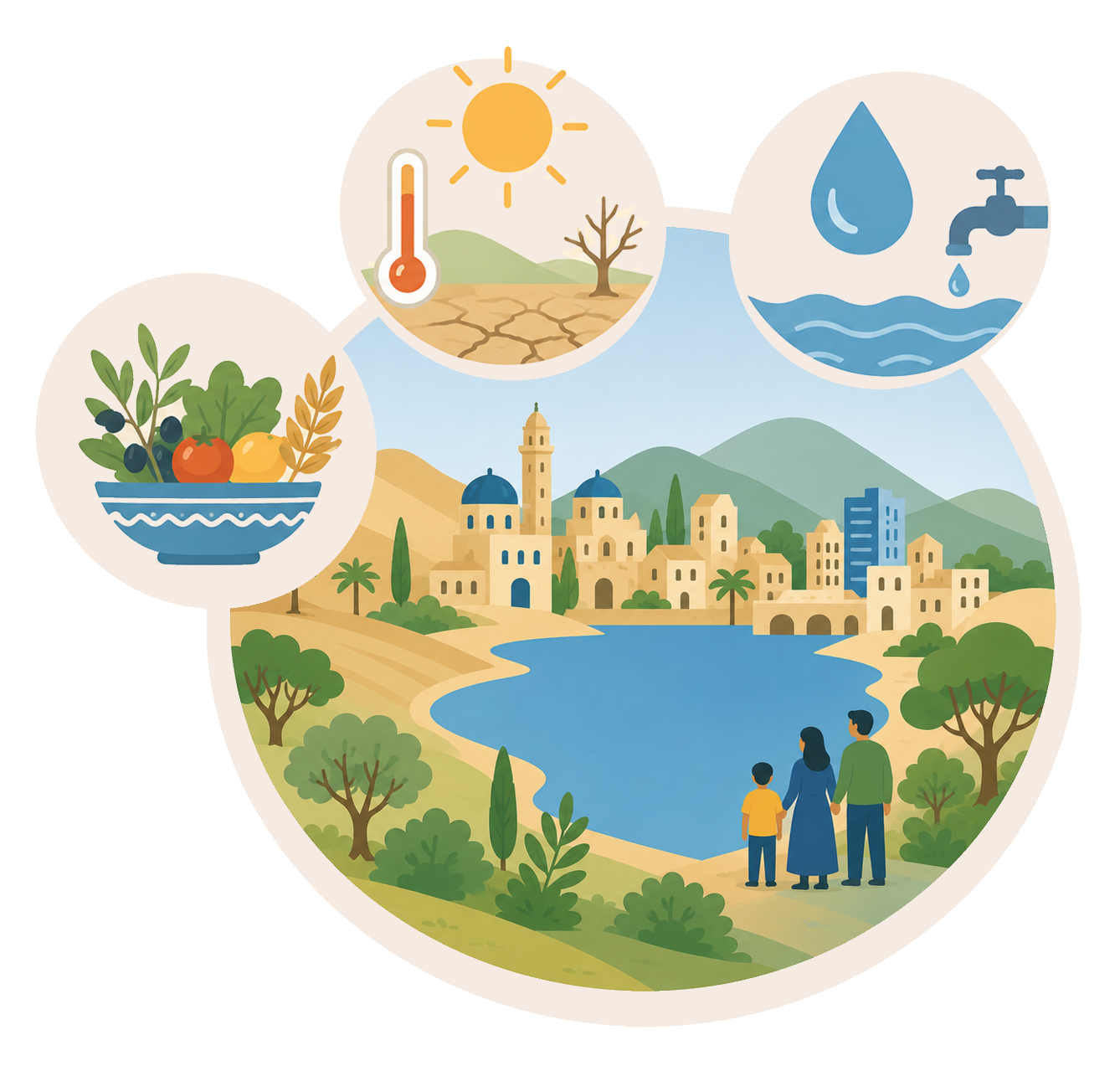
For farmers, pastoralists, and fishers, these pressures translate into difficult choices. Some abandon crops that once sustained their families, while others turn to less water-intensive varieties. Rising feed costs as rangelands degrade are yet another challenge. At sea, warming waters and overfishing reduce fish stocks and biodiversity. For households across the region, the effects often appear as higher food prices, fewer choices, and growing uncertainty.
Foods such as figs, olives, thyme, durum wheat, dates, and citrus are part of the Mediterranean's identity. When they decline, cultural heritage and livelihoods are at risk.
The loss is not only economic. Foods such as figs, olives, thyme, durum wheat, dates, and citrus are part of the Mediterranean’s identity. When they decline, cultural heritage and livelihoods are at risk. And the challenge does not stop at farms or markets. Water, food, energy, and ecosystems are deeply interconnected.
Food production accounts for roughly a quarter of the region’s total energy use. Energy generation, in turn, depends heavily on water — for cooling power plants, running desalination facilities, or irrigating crops. In fact, energy costs can make up a significant share of water and wastewater utilities’ operating expenses.
Meanwhile, ecosystems — wetlands, forests, rangelands, rivers, and coastal zones — provide the foundation for resilience. They filter water, store carbon, reduce floods, and support biodiversity. Yet they are under growing pressure from pollution, overuse, and poorly planned infrastructure.
This is why the Water–Energy–Food–Ecosystems (WEFE) Nexus matters so much in the Mediterranean. It recognizes that these systems cannot be managed separately. Decisions made in agriculture affect water availability, energy demand, and ecosystems. Energy choices influence water use and emissions. Poorly planned investments in one sector can unintentionally harm the others.
A WEFE approach encourages integrated solutions. These might include improving irrigation efficiency while protecting ecosystems and soils, using renewable energy to reduce pressure on water resources, or designing “no-harm” policies— even when not all objectives can be fully achieved at once. Integration is complex, but it is both possible and necessary.
In practice, this means viewing the Mediterranean as a connected whole—from mountain springs and rivers that flow through farmland and cities, to deltas, coasts, and the sea. Pressures upstream often cascade downstream. Deforestation accelerates floods and erosion; polluted rivers damage fisheries and marine ecosystems. Managing these links helps protect both livelihoods and nature.
The story of water, food, and climate change in the Mediterranean is therefore not only one of risk, but of choice.
Climate adaptation also happens on the ground. Across the region, communities have long histories of resilience. Farmers terrace their slopes to retain soil and water, harvest rain in cisterns, and save heat-tolerant seeds. Many of these practices remain powerful today. When combined with modern tools — such as efficient irrigation, renewable energy, climate forecasting, and digital monitoring — they offer a stronger foundation for facing climate change.
The story of water, food, and climate change in the Mediterranean is therefore not only one of risk, but of choice. By managing water, energy, food, and ecosystems together, valuing local knowledge alongside innovation, and protecting biodiversity, communities can preserve the landscapes, harvests, and ways of life that define the region.
Climate change is already here — but so are the opportunities to act, together, for today and for generations to come.
Is your climate changing?
Take this quick quiz and see how climate change is unfolding where you live.